
Life today exists in the time of algorithms. Every click, every search, every keystroke, every hesitation is studied, added to a database, and used as input into calculations that determine how much you will pay for something before you leave a website. The algorithm doesn't know you the way your friends know you, it knows you the way a poker player knows your tells.
The algorithm, turbocharged by AI, is expanding outward into new territories that affect life in new and challenging ways. It affects who works, the taxes you pay, how much wealth individuals accumulate, and who runs the country. Most of us are coasting through life without knowing the rules. And the rules can change at a moments notice, without warning. It's time to learn the rules, study the rules, and figure out how to make things better. Right now AI is like a temple, first you create it, then you pray. It doesn't have to be that way.
America has a debt of about $40 trillion. This works out to about $116,000 for every citizen in this country. This includes those too young, too old, and too disabled to vote. There are about 90 million single family homes in America that are owner owned, with an average value of $400,000 (from HomeSnacks). This means the national debt is greater than the sum total of all single family homes owned in America. The debt keeps growing larger without any proposals that even resemble a politically acceptable solution. Some proposals that float around are: raid social security, cut medicare, slash the military, and confiscate a large chunk of billionaire wealth. They all have a similar problem. They introduce more crises than they attempt to fix. Analysis of these massive all at once transfers reveals that none of them are ever given serious attention by politicians. A more elegant solution, with less shock value, is needed, because doing nothing will inevitably lead to its own catastrophe.
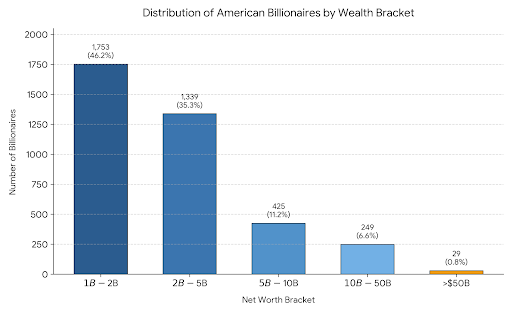
There is widespread belief that the small number of billionaires in this country do not pay their fair share to the government to cover expenses. Altrata, a leader in global wealth intelligence, reported the nearly 3800 billionaires in this country have a combined wealth of $15.1 trillion. AI investors experienced market valuations that climbed 23% faster than those that did not invest in AI during the 2024 - 2025 time period. The billionaires that have a net worth of $50 billion or more, control more than 25 percent of all billionaire wealth, thereby making the wealth gap worse. Very few billionaires express any interest in addressing the wealth gap, and they definitely do not want to hear about additional taxes they might have to pay.
1753 billionaires are worth between $1B - $2B.
1339 billionaires are worth between $2B - $5B.
425 billionaires are worth between $5B - $10B.
249 billionaires are worth between $10B - $50B.
29 billionaires are worth more than $50B.
Many voters believe the government should pay attention to, and learn from, the way corporations and companies run their businesses. There are corporations that have grown significantly and now have market caps valued at trillions of dollars, while the government is trillions of dollars in debt. Perhaps governments can learn important strategies by studying corporate behavior. There's no harm in investigating ideas that are based, at least partially, on existing corporate practices to see if this inspires ideas that show promise. It just might generate some interesting discussions and eventually lead to solutions that will help address unacceptable government debt.
Dynamic pricing is a popular corporate strategy that adjusts prices based on supply, demand, and more recently, on who is doing the purchase. A classic example of dynamic pricing is how the fare price of airline seats changes every time you log into that airline's website. The price is determined by how full the plane is, when you book it, and whether the algorithm decides you need to get to your destination by next Tuesday. Dynamic pricing is used to create additional revenue. It didn't take airlines long to realize that algorithms can be enhanced by including additional information such as, is it an aisle or a window seat.
In general businesses use algorithms to implement dynamic pricing and these algorithms are subject to change. More recently AI has become an important part of algorithmic pricing decisions. Thanks to AI, cloud computing, and databases, dynamic pricing includes more than just the product that is for sale when the price being offered is determined. These new approaches also base the price on the demographics of the person doing the buying. For instance, online sellers gather as much information as they can about who buys their products and services. They create and display web pages that show higher prices if the data gathered about this buyer indicates they are likely to buy at higher prices. Similarly, if the profile suggests the presence of a bargain hunter, lower prices are offered. These new AI algorithms are no longer pricing solely on the goods or services being offered, the price is also based on the accumulated data that describes this profile. The algorithm determines an acceptable maximum price (the pain point). This use of personal information is controversial and has generated legal challenges to some dynamic pricing behaviors. However legal proceedings can take a long time to resolve, especially when corporations have access to large datasets, expensive law firms, and the willingness to appeal unwanted verdicts. Algorithms can change in tricky and non-obvious ways, and all of this limits the chances of success when an unhappy buyer challenges these new dynamic pricing techniques. All prices can change over time. All items can go on sale at any time and later go off sale. The issue most people have is the way undercover and personalization techniques are used by these new algorithms to determine the price that is displayed. No false advertising exists because the advertised price of goods and services displayed on, say a web page, will be honored by the corporation making the sale. Currently these new dynamic pricing techniques are in play and are sometimes called surveillance pricing.

So, as already mentioned, the government is deeply in debt, billionaires are often accused of not paying their fair share, and the government is encouraged to start paying attention to how corporations and businesses operate. Dynamic pricing is a popular corporate strategy that has shown it generates an appealing revenue increase when used in certain ways. Perhaps similar practices could also be successful when applied to other revenue needs. Perhaps it's a good way for the government to raise additional revenue and help pay down the debt. Dynamic pricing is a popular technique that successfully creates additional revenue for corporations. It's safe to say that dynamic pricing is not going away because it is a well established corporate practice that will keep expanding into new areas as the underlying algorithms are adjusted. Recent AI enhancements to these algorithms are also good for corporate bottom lines (i.e., net profits). Why not apply an effective practice, that has proven to increase revenue, into other domains.
An expansion like this, into a new domain, requires a new name that is not tainted by what is perceived as being undesirable (like the word tax). For example, there are already algorithms that are used to determine the percentages paid when taxes are calculated. Unfortunately these algorithms determine that the very richest tax payers should pay very small percentages of their wealth while everyone else pays larger percentages. This behavior of a complicated algorithm means the current taxation system can already be referred to as dynamic taxation. The word 'dynamic' is used to describe the reality that some people, determined by an algorithm, pay more than others (just like dynamic pricing). This new strategy is called Dynamic Revenue Generation. Just like tariffs, it's not called a tax (*wink*).

Governments provide goods and services to its citizens. For example they construct roads (goods) and inspect food (services). Governments need revenue to pay for these goods and services. AI models are powerful and getting more powerful with each release of a new model. The point is that AI can be used to make improvements to society as a whole. There are concerns about AI being used to eliminate worker's jobs as current AI models are trained to perform tasks that human workers perform today. The majority of people want AI models to act in more humane ways. And reducing government debt is beneficial for everyone. This would also be true if AI, for example, can reduce the cost of healthcare and housing. If AI eliminates many more jobs than it creates, then the amount of revenue the government raises through income taxes will be noticeably reduced. The question becomes, if needed, can AI models be trained to do more good in areas searching for solutions? An examination of past AI behavior will be helpful here.
Let's take a short side trip and look at how AI performed when it was applied to computer chess games. Computer chess games have been around for decades. In the 1960s and 1970s these games were curiosities that good chess players found amusing and not that difficult to defeat. In the late 1980s the best chess engines could beat some grandmasters because chess engines became more powerful. In 1996 IBM's Deep Blue chess engine beat the current world chess champion. Neural networks were introduced and by 2017 new chess engines used these neural networks to dominate human chess players. Neural networks are loosely based on the architecture of human brains. It's not the same as a human brain but is inspired by them. This technology is powerful and becomes more powerful as computer architectures become more powerful. This increasing power allowed chess engines to develop new and better strategies. Chess engines did not get better by being programmed with better moves. They got there by playing millions of games against themselves at compute speeds and continuously learning new strategies. Today, no humans can beat the best chess engines in tournament play. Similarly, an AI computer program, AlphaGO, first beat a human professional GO player (a board game that is by far more mathematically complex than chess) in 2015. After May 2017 humans stopped being able to beat AlphaGO. The speed at which AI becomes more powerful continues to dramatically increase at faster rates, especially when compared to human progress. Clearly AI can be given tasks and trained to outperform humans over time.

Current AI models use neural networks, which are continuously improved upon by using similar techniques to those used to develop winning chess and GO strategies. Again, AI models become more powerful as they improve. A recent and promising (perhaps concerning) process under development is called Recursive Self-Improvement (RSI) in which Artificial General Intelligence systems modify their own code, thereby allowing AI to develop new versions of themselves. That is, AI is building itself and becoming more powerful at a faster rate. When RSI is fully functional, the power of AI models will increase at compute time and not be limited to human engineering time. It's safe to assume that corporations will use newer and more powerful AI to generate more profits, that will be concentrated in the hands of the nearly 3800 billionaires in this country (current status quo). If AI performs better and better at a faster pace, it's not hard to believe that AI can be trained to pursue tasks that decrease the national debt, or to pursue tasks that increase the concentration of wealth. The direction AI heads depends upon the tasks it is given and the training it receives.
Certainly AI has demonstrated that, over time, it becomes more powerful. Humans beat chess engines and AlphaGO when AI first started playing these games. Not anymore. AI models are now producing solutions to 90 year-old mathematical problems like the Navier-Stokes problem (solved in 88 hours). When the power of AI continually increases at compute time, eventually humans are no longer able to compete. Perhaps this can be used in a way that generates positive societal outcomes like reducing the national debt.
For this reason exploring how AI models can improve society makes sense. If AI is given tasks that, if successful, improve lives, it's reasonable to assume that, just like chess engines reaching a state where no humans can compete with them, newer more powerful AI models will eventually perform better than humans at improving lives. It's better to start monitoring and training AI behavior now so that AI leans toward improving society, than to let it run free, or to turn complete control over to a few very wealthy corporations. Corporations use money to keep score, and not to improve society. AI models can be trained to identify behaviors that are likely to improve society. Eventually they will succeed.
A new technology called 'interpretability' is being developed to explain why AI neural networks make the decisions they do. AI interpretability is conceptually similar to neuroscience where neurologists study human brains to determine which neurons in a brain are active for various human behaviors and emotions. These studies can help identify treatments that are intended to improve an identified adverse human condition. These treatments can lead to beneficial treatments for certain populations. Because neural networks are only loosely based on the architecture of human brains, more study is needed. However, there are reasons to be optimistic that studies using interpretability of AI neural networks can be used to identify neural states likely to lead to problematic behavior, and states that are likely to lead to positive outcomes. These studies can predict needed actions and tasks that will lead to societal improvements. Instead of identifying which human neurons (i.e., brain activity) is causing concern, AI interpretability follows a similar pattern that can help identify the causal mechanism of a neural network that leads to adverse AI conditions. This allows humans to study which AI tasks cause positive societal outcomes, and which cause negative outcomes. Just as dynamic pricing is not going away, AI is not going away either. It's best to explore using AI's predictive capabilities to introduce positive changes that benefit society as a whole. The main point is that it's reasonable to believe AI can be used to improve society.
Once again, before you vote, it's important to know what political candidates positions are on issues such as the debt, the concentration of wealth, construction of data centers, the need for AI guardrails, and who is studying the safety of how new AI models are used.